Dr. Yewande Pearse
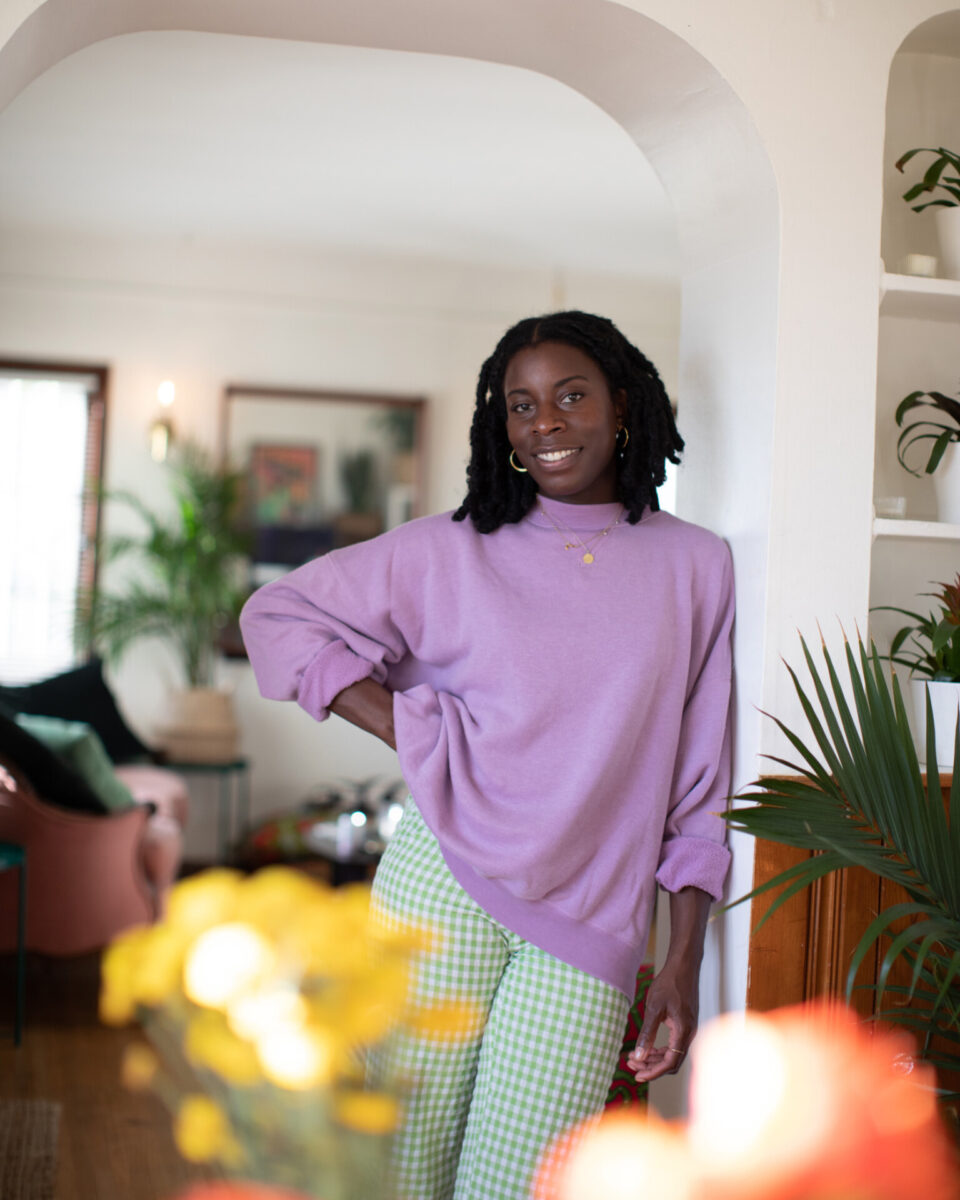
The esteemed neuroscientist Dr. Yewande Pearse is a tireless advocate for science accessibility and her work exists at the crossroads of science, culture, and art. When she is not in the laboratory researching stem cell therapies for brain disorders she is hosting radio shows, podcasts, and consulting and collaborating with TEDMED, DEEM Journal, Massive Science, and more. She is also a member of the board of directors for the art space Navel, where she hosted a 2019 workshop, ‘Science in the Media.’ The workshop hosted group discussions about media coverage of science topics, which felt almost like “group therapy” sessions for science news. These collaborative discussions around news and the media were an important inspiration for the development of the Artist News Network, and I can’t thank her for it enough.
Dr. Yewande Pearse is a neuroscientist and science communicator. She has dedicated over 10 years of research to understanding rare genetic brain disorders at both King’s College London and The Lundquist Institute (@thelundquistinstitute) at Harbor-UCLA. Her communication work includes hosting Sound Science (@soundsciencepodcast) on Dublab Radio (@dublab) and Inside Biotech, a podcast from Biotech Connection Los Angeles. She has also worked with Headspace, Seed, Deem Journal, NAVEL, Fathomers, Massive Science, TEDMED, and more.
Photo by @katebe_
Articles
Dec 17, 2021
‘Amazing science’: researchers find xenobots can give rise to offspring
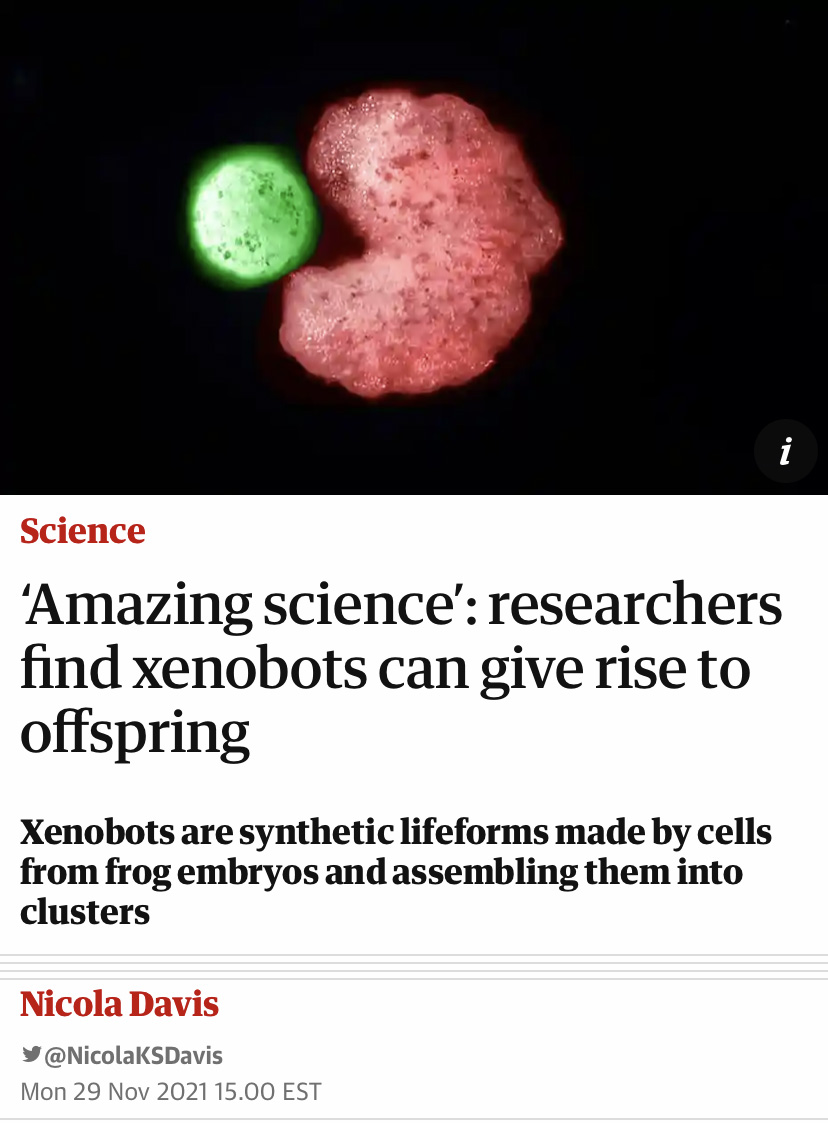
Ending the week with a bit of cell biology news from my field of study! Synthetic biology is wildly fascinating once you get past the hefty jargon to the story. The original paper published in the journal PNAS and entitled ‘Kinematic self-replication in reconfigurable organisms’ really is as the title of the article states – ‘amazing!’. Xenobots are synthetic lifeforms made by cells from frog embryos. The reason why they are amazing is unlike all other living species that replicate themselves by reproducing in pairs, alone or with a little help from another living thing, Xenobots have a unique way of replicating. These little clumps of cells, move around sweeping up loose cells to create new clumps – baby Xenobots! Check out the video in the second slide – it’s pretty cool. It shows how a swarm of frog-cell parents push frog cells into piles that mature into self-moving “children” with the further help of AI.
Link to the original research article Here


Published by The Guardian
Nov 29, 2021
Read the article Here
Dec 16, 2021
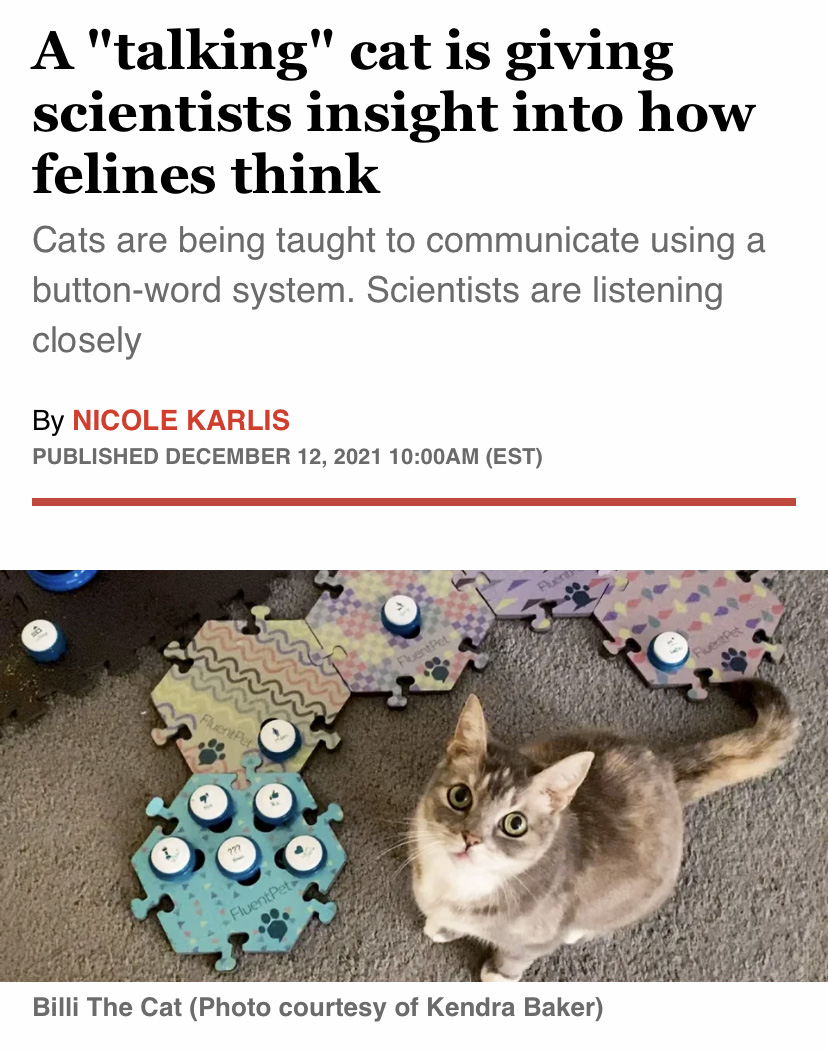
A ‘talking’ cat is giving scientists insight into how felines think
My TikTok feed and Instagram ads will tell you that I quite like cats. Along with science, cats are one of my favourite things so I had to sneak this one in for fun. My cat, Stedman Misdemeanour Pearse, doesn’t actually ‘meow’, he sometimes makes another noise instead but I don’t think he’s figured out the whole vocal communication yet. As a side note, meowing is a cat-human communication vocalization, and uncommon in cat-cat communication. Even though they have a special “language” just for us, most of us “don’t get cats” so for those who care – this article might come as good news! The story is based on a study called the ‘TheyCanTalk study’ led by Kellie Marks, along with a couple of cognitive scientists from UC San Diego and an AI Engineer in Cambridge working with language data who used to work on the cognitive science of self-driving cars at MIT. I was excited to see that there may be some scientific basis to this story, but as happy as it would make me to have Stedman tap out “I love you” one day, I’m not sure how far beyond classic Pavlovian conditioning it goes.
Published by Salon
Dec 12, 2021
Read the article Here
Dec 15, 2021
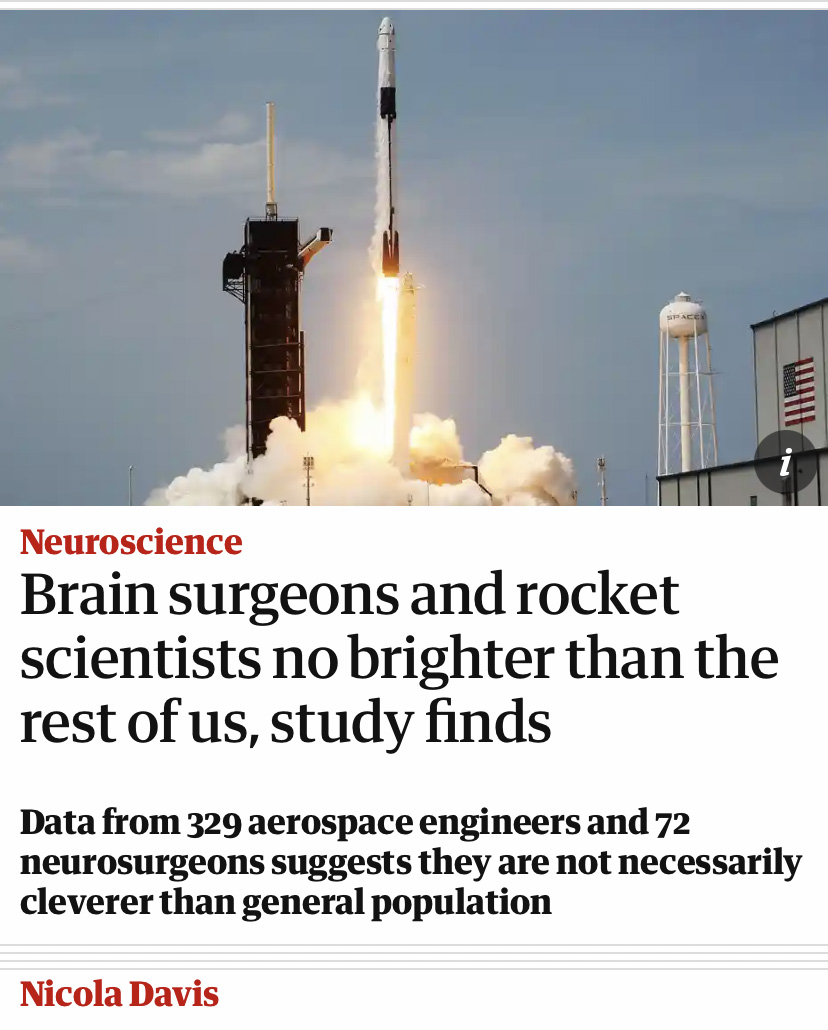
Brain surgeons and rocket scientists no brighter than the rest of us, study finds
This story has been making the rounds in the news, which makes sense because who doesn’t want this kind of validation? The original findings were published in the BMJ a couple of days ago based on a series of cognitive tests – the Cognitron Challenge – developed by Imperial College London and the BBC to push planning, reasoning, working memory and attentional abilities to the limit amongst people from the UK, Europe, the United States, and Canada. The study concluded “In situations that do not require rapid problem solving, it might be more correct to use the phrase “It’s not brain surgery.” It is possible that both neurosurgeons and aerospace engineers are unnecessarily placed on a pedestal and that “It’s a walk in the park” or another phrase unrelated to careers might be more appropriate. Other specialties might deserve to be on that pedestal, and future work should aim to determine the most deserving profession.”
What’s your practice or speciality? Should we be saying “It’s not (insert profession here)” instead? Give it a go! You can do the test yourself via the link below. Scientifically speaking, an n=1 isn’t going to tell you much about your field as a whole, but it might be cool to know that you score higher than the 329 aerospace engineers and 72 neurosurgeons in the study.
Link to test Here
Published by The Guardian
Dec 14, 2021
Read the article Here
Dec 14, 2021
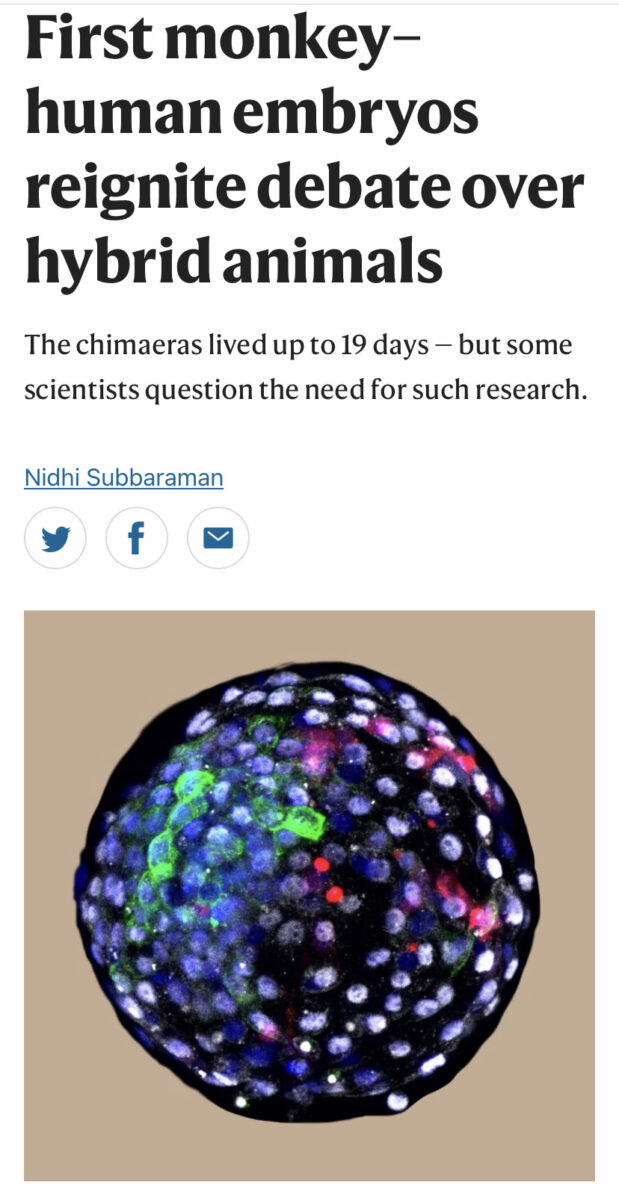
First monkey–human embryos reignite debate over hybrid animals
This image made Nature Journal’s ‘Best science images of 2021’ list put together by Emma Stoye. The image, captured using sophisticated immunostaining and microscopy techniques, is of a hybrid embryo – both monkey and human. The original paper was published in Cell on April 15th (Link Here).
In April, scientists reported successfully growing the first monkey embryos containing human cells. Human–animal hybrids might one day provide better models for testing drugs, or be used to grow human organs for transplants. But the field has also raised ethical questions.
Published by Nature
Apr 15, 2021
Read the article Here
Dec 13, 2021
How the mixed-race mestizo myth warped science in Latin America
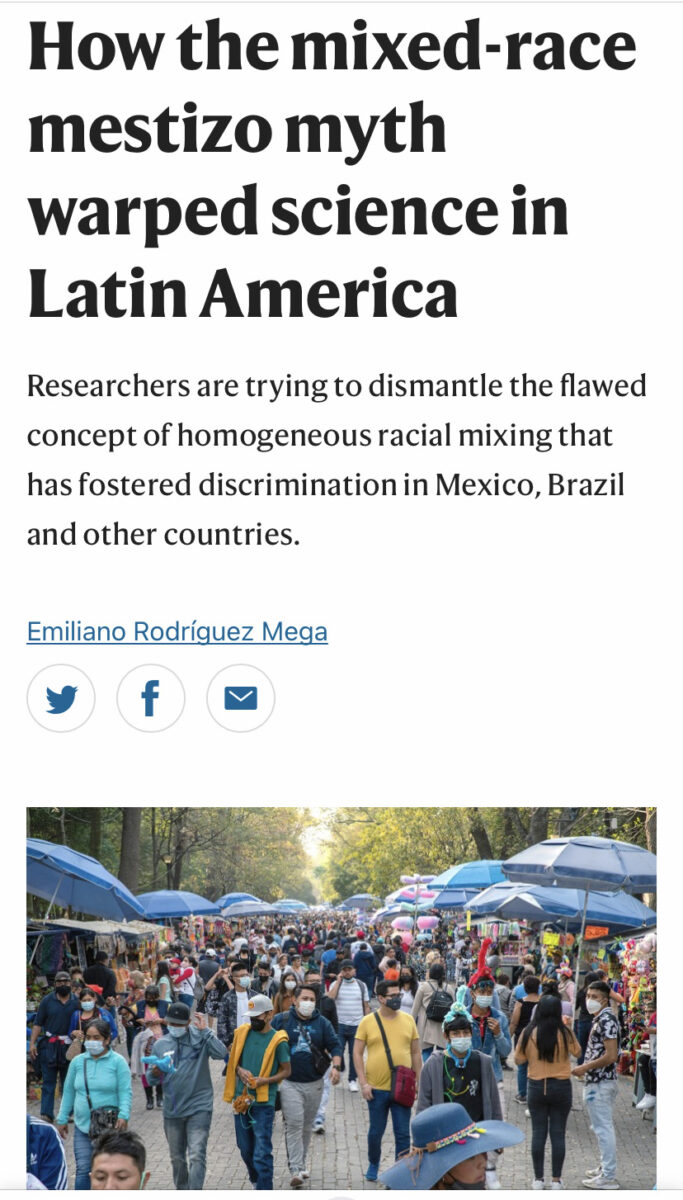
I’ve been fascinated with how genomics informs identity for a while. Back in 2019 I hosted a 5-day program at NAVEL, Los Angeles. The program entitle 0.1%, aimed to demystify how genomics inform identity with an exhibition, a presentation by Dr. Aaron Panofsky and Dr. Terence Keel from the UCLA Institute for Society and Genetics, and the release of a NAVEL x Massive Science collaborative zine on the impact of genomic studies on three aspects of identity: race, gender and politics. Almost 3 years later and I’m still discovering new depths to the discussion; from the ever evolving problems around ‘Blood Quantum’ to developments in epigenome editing, where rather than using tools like CRISPR to change the genetic code, the code is kept the same and regions of the genome are turned off or on (will post on that later this week). This article talks about another important argument at the intersection of genomics, race and society.
You can checkout more about the 0.1% program Here
Published by nature
Dec 13, 2021
Read the article Here